
Your AI Doesn't Know Your Business
Why we built Statespace, and what we learned along the way
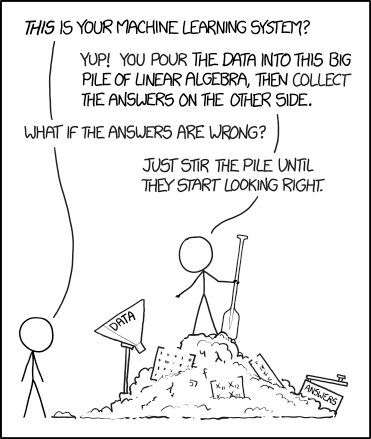
How most AI "engineering" works today. From xkcd #1838.
You’re falling behind. Every minute you wait, another competitor ships AI features. New protocols crown themselves the standard, vector databases get 3% faster. The singularity is coming and you’re gonna miss it!
Don’t worry, we get it. That’s just what it feels like right now.
But here’s what we learned building our first product: even the best models can’t pick up your business context from nowhere. GPT-5.4 doesn’t know that in your database, sales in one table is revenue_2016 in another. Claude doesn’t know that Customer A wants casual responses while Customer B expects formal docs.
So we built something different.
Statespace: open, composable building blocks for your system
Statespace is an open source framework that gives you transparent primitives to build APIs purpose-built for agents.
Statespace apps are just Markdown files: you declare tools the agent can call, write instructions explaining your domain-specific context, and set guardrails on what’s allowed. Agents interact over HTTP, discover your tools, and use them.
One app for your sales database access patterns, another for legal’s compliance rules, a third for internal observability metrics. Each app is scoped to exactly the context, tooling, and guardrails it needs, maintained by the team that owns it.
Since deployed apps are just URLs, they’re shareable anywhere: in Slack, embedded in docs, referenced in code comments, or chained together as part of more complex workflows.
Talk is Cheap. Show Me The Code
Here’s a simple text-to-SQL app:
# README.md in sqlite-3/

---
tools:
  - [sqlite3, store.db, { regex: "^\\s*SELECT\\b[^;]*(;\\s*)?$" }]
---

# E-Commerce Store

Use `sqlite3` to query the database. Only SELECT queries allowed.

## Schema
**customers** — id, name, email, city, country, joined
**products** — id, name, category, price
**orders** — id, customer_id, product_id, quantity, ordered_at
That’s it. Deploy the app, point an agent at the URL, and it reads your instructions, discovers your tools, and follows your guardrails. You own the context and control what it can do.
Why We Learned This The Hard Way
This didn’t come to us overnight. Our first product was a vectorless database RAG library. It did surprisingly well on tough benchmarks like SPIDER-2.0, but failed in production.
The problem: every API we were asking agents to use was designed for humans, not AI agents. Like it or not, peak production code is full of cryptic interfaces and tribal knowledge. When agents try to navigate these systems, they get lost and confused.
Human APIs work well for humans, but agents need something different: clear instructions about what they’re doing, discoverable tools with schemas they can understand, and guardrails that keep them in check. That’s what Statespace gives you. Whether you’re wrapping legacy systems or building something entirely new, you can give agents interfaces they can actually use.
Middleware and fine-tuning try to patch over this gap, but they can’t fix foundations that were never designed for AI in the first place.
We realized it’s impossible to capture a company’s unique context in a generic black box. So we built Statespace to create specific APIs maintained by the people who actually give a shit about that particular piece of the puzzle.
So No, You’re Not Falling Behind
Everyone’s selling you AGI and agent swarms, when we haven’t even built the foundations properly yet.
Statespace is our bet that superintelligence isn’t coming as one giant monolithic God model. It’s coming as a network of composable systems that teams build themselves.
Build your first app in five minutes, or read the docs to see how the agent discovers your tools. No black boxes. No fine-tuning. Just context, finally done right.